
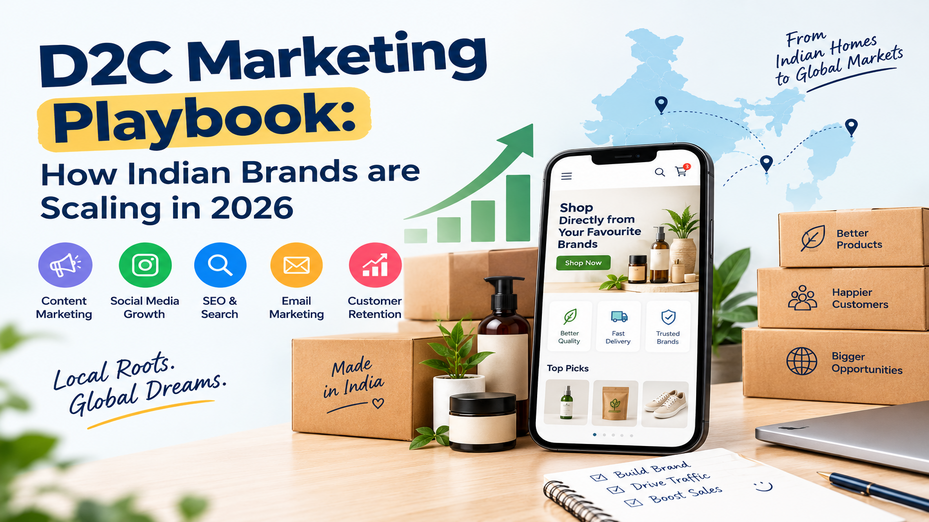
If you are searching for how D2C brands grow fast, the answer in 2026 is very different from the old "run more Meta ads" playbook.
Indian D2C brands are entering a more disciplined phase. Customer acquisition costs matter, repeat purchases matter, margins matter, and a brand cannot depend on one platform for growth. Recent industry research points to the same shift: D2C growth is moving towards omnichannel distribution, quick commerce, stronger retention and better operational efficiency.
At GBIM, we see D2C growth as a connected system. Paid media may bring the first purchase, but product pages, SEO, creators, CRM, customer experience and retention determine whether that purchase becomes a business.
Here is the playbook we recommend for Indian D2C brands in 2026.
D2C, or direct-to-consumer, means selling directly to customers instead of relying entirely on traditional distributors or retail networks.
The advantage is obvious: you own more of the customer relationship and collect valuable first-party data.
The challenge is just as clear. You also have to create demand, acquire customers, convert them, fulfil orders and convince them to come back.
That changes the marketing question from:
"How do we get more sales?"
to:
"How do we acquire the right customer at a cost the business can sustain?"
That distinction matters when you start scaling.
Fast-growing D2C brands rarely try to sell everything to everyone.
They identify a specific customer problem and make the product promise easy to understand.
For example, a skincare brand could target "women aged 18-45" and stop there. Or it could build campaigns around a much clearer need such as acne-prone urban consumers looking for a simple daily routine.
The second approach gives marketing something useful to work with.
Before increasing ad spend, we recommend defining:
Your advertising, content and landing pages should all reflect the same customer insight.
Many D2C brands focus heavily on acquiring traffic and then send that traffic to weak product pages.
That is an expensive mistake.
Your product detail page needs to answer the questions a customer would normally ask a salesperson:
What does this product do?
Who is it for?
Why should I trust it?
How is it different?
How much does it cost?
When will it arrive?
What happens if I don't like it?
Strong product pages usually combine clear copy, useful product photography, demonstrations, reviews, FAQs, delivery information and obvious calls to action.
We also look at mobile experience, page speed, checkout friction and analytics before recommending more media spend.
Our ecommerce digital marketing guide covers this broader conversion framework in more detail. GBIM's ecommerce digital marketing guide
Meta and Google can generate sales quickly, but depending on them for every sale makes the business vulnerable.
A stronger D2C acquisition mix usually includes:
At GBIM, our digital advertising approach starts with the market, audience and purchase intent before campaign execution. GBIM's digital advertising services
The goal is not to find the platform with the cheapest click. It is to find the combination of channels that produces profitable customers.
D2C advertising changes quickly because customers see the same formats repeatedly.
A campaign that works today can become ordinary within weeks.
Instead of creating one "perfect" ad, build a testing system.
Test different:
Do not judge every creative only by CTR. A high-click ad that attracts poor-quality customers can hurt the business.
Look at the complete path from impression to purchase and, where data allows, repeat purchase.
Influencer marketing works best when the creator can explain why the product belongs in their routine.
For a beauty brand, that might mean a creator demonstrating the product over several weeks. For a food brand, it could be a recipe. For fitness products, it could be a genuine use case rather than a polished product shot.
The useful question is not:
"How many followers does this creator have?"
It is:
"Can this creator make the right customer believe this product is worth trying?"
Micro and niche creators can be particularly useful when the product depends on trust, education or community.
A first purchase is not the finish line.
If customers buy once and disappear, your acquisition economics become harder to sustain.
Retention should start immediately after purchase.
Build lifecycle journeys around:
Email, SMS and WhatsApp can become important retention channels, particularly when the product has a predictable repurchase cycle.
This is one reason we treat customer data as a marketing asset rather than simply a reporting number.
India's next wave of D2C growth is not limited to Mumbai, Delhi, Bengaluru and other major metros.
Research from IMA India highlights Tier-2 and Tier-3 demand, while recent D2C logistics data also points to a large share of future customers coming from outside metros.
But expanding geographically is not simply a matter of changing the location targeting in Meta.
You may need to adapt:
The brand should feel relevant locally without losing its core identity.
"Direct-to-consumer" does not have to mean "website only."
In 2026, marketplaces and quick-commerce platforms increasingly function as additional digital shelves.
For products suited to fast consumption or urgent purchase, quick commerce can help create trial and convenience.
The important part is channel economics.
Before expanding, calculate the margin after platform fees, discounts, fulfilment, returns and advertising. More orders do not automatically mean better growth.
Paid advertising creates demand. Search can capture demand that already exists.
Build useful pages around questions customers actually ask:
Strong category pages, product pages, comparisons, buying guides and FAQs also give search engines clearer information about your brand.
At GBIM, our SEO services include strategies designed around search visibility and AI-powered search environments. GBIM's SEO services
This is where many agency relationships slow down.
If you want us to build a serious D2C growth programme, we need more than access to your ad account.
We need:
The clearer the commercial picture, the better we can decide where marketing money should go.
At GBIM, we do not look at SEO, paid media, content and social as separate activities.
We connect them to the commercial goal.
We can help with audience research, SEO, performance advertising, content, social media, landing pages, conversion optimisation and analytics. Our ecommerce marketing capabilities can be structured around the stage your brand is actually at, whether that means fixing conversion before scaling or building a broader acquisition engine. GBIM's ecommerce marketing approach
The real objective is simple: acquire better customers, convert them efficiently and give them a reason to return.
They usually combine strong product-market fit with paid acquisition, organic search, creator content, conversion optimisation and retention. Fast growth becomes more sustainable when the brand is not dependent on one channel.
Scaling advertising before fixing the website, product pages, customer experience and unit economics. More traffic cannot compensate for a weak conversion or retention system.
Usually not. Meta can be an important acquisition channel, but brands should also develop Google, SEO, creators, CRM, marketplaces and other relevant sources of demand.
It depends on the category and economics. Marketplaces can expand reach and capture purchase intent, but brands should calculate platform fees, discounts, advertising and fulfilment costs before expanding.
Very important. Improving repeat purchases can make customer acquisition more sustainable, especially when paid media becomes expensive.
At minimum, track revenue, CAC, conversion rate, average order value, contribution margin, repeat purchase rate, return rate and channel-level profitability. Looking only at ROAS can hide problems elsewhere in the business.
309, Rupa Solitaire,
Sector-1, Millennium Business Park,
Mahape, Navi Mumbai,
Maharashtra (400 710), INDIA.
Write to us at
hr@gbim.com