
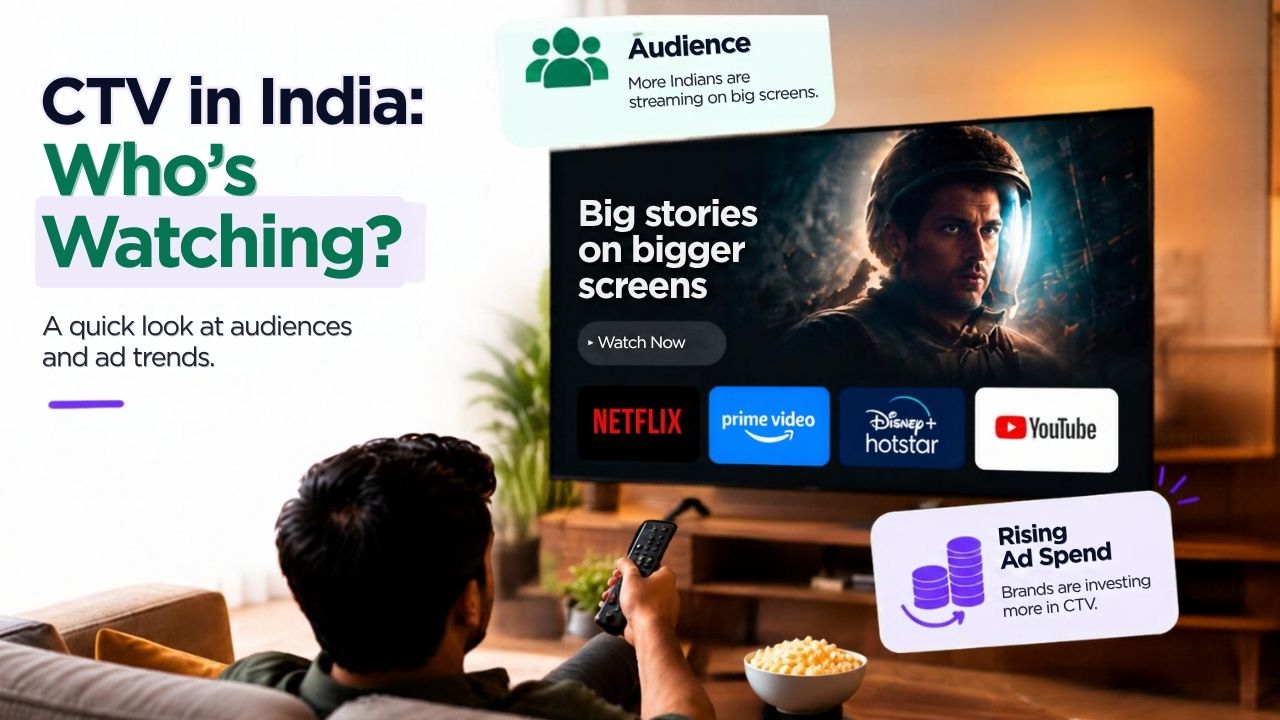
For decades, buying television airtime in India meant committing substantial budgets to national broadcast networks and hoping your target customers were on the couch during a commercial break. The rise of broadband-connected living rooms has changed that math. Today, connected TV advertising India allows businesses to display high-definition video ads on large screens while using the audience targeting and measurement tools typical of digital campaigns.
Yet, as interest in connected television grows, so does the confusion around who is actually watching and how media budgets should be allocated.
This guide breaks down current viewership patterns in India, clarifies the numbers behind connected screens, and examines how brands can evaluate connected TV as part of their media mix.
Marketing discussions often treat connected TV (CTV) and over-the-top (OTT) streaming as interchangeable concepts, but they describe different parts of the viewing experience.
OTT refers to the method of delivering video content over the internet rather than through satellite dishes or cable lines. Hotstar, YouTube, SonyLIV, and Zee5 are OTT platforms. Viewers can watch OTT content on a phone, a tablet, a laptop, or a television.
CTV refers specifically to the device and screen environment. It covers any television set connected to the internet, whether through built-in smart TV software, a streaming stick, an internet set-top box, or a gaming console.
When you run smart TV advertising or CTV campaigns, you are buying ad placements delivered to a television screen via internet connectivity, not mobile phone feeds.
Industry pitch decks often cite staggering figures, sometimes claiming there are over 200 million connected TV households in India. It is worth looking at those numbers critically.
India has approximately 210 to 230 million total television households. The vast majority of these homes still watch linear television via standard cable and direct-to-home (DTH) satellite connections. Industry estimates from media research groups and streaming networks place the actual number of active connected TV households in India between 35 million and 45 million, primarily concentrated in urban and semi-urban areas with high-speed home broadband.
The higher figures frequently cited in market commentary usually conflate total linear TV households, individual streaming viewers across mobile devices, or total internet users with dedicated connected TV screens.
For media planners, the practical takeaway is clear: CTV does not yet have the universal reach of traditional broadcast television across rural India, but it provides concentrated access to middle- and upper-income urban households that have largely stopped watching standard cable.
The audience profile on connected screens differs noticeably from personal mobile viewing.
Indian streaming audiences have consistently shown a preference for free or low-cost viewing options. While pure subscription video-on-demand (SVOD) models exist, the market has shifted toward advertising-supported models.
For advertisers, ad-supported streaming provides consistent inventory on premium content without relying solely on users paying for expensive ad-free tiers.
Connected TV ad spend is distributed across three main channels:
For small and medium-sized enterprises, traditional television advertising has historically been out of reach due to minimum budget requirements and broad, non-targeted distribution.
CTV advertising in India changes that dynamic by introducing targeted media buying to the television screen:
Running CTV campaigns works best when integrated with a broader digital advertising strategy that includes search and retargeting ads, ensuring that interest sparked on the TV screen converts into website traffic and sales on personal devices.
A video produced for an Instagram Reel or a mobile feed rarely works well on a television screen.
Connected TV ads require high-resolution landscape formats (16:9), clear audio mixing designed for home soundbars, and pacing that respects the viewing environment. Because many CTV placements are unskippable 15-second or 30-second spots, the opening five seconds must establish your brand identity clearly.
Investing in high-grade video production services ensures your creative assets look professional on modern 4K displays rather than appearing pixelated or poorly adapted from mobile assets.
Connected TV measurement is improving, but it operates differently from standard performance marketing.
Platforms provide dependable figures for impressions, unique household reach, and video completion rates (which often exceed 90% on non-skippable television formats). However, direct response tracking is indirect. Viewers see an ad on their TV, but they search for your brand or make a purchase on their mobile phone or laptop.
Marketers evaluate CTV campaign success by tracking brand search lift, direct website traffic spikes during broadcast windows, or using on-screen QR codes for promotional redemptions. Setting expectations around brand awareness rather than immediate direct-click conversions prevents strategic mistakes.
Connected television is expanding rapidly across urban India, providing brands with an effective way to enter the living room without the waste of traditional broadcast buys.
Evaluating this channel requires a practical look at your audience location, creative readiness, and budget. For businesses looking to build visibility, connected tv advertising india offers a targeted path to high-impact video advertising.
At GBIM, we help businesses evaluate emerging digital channels and build focused video campaigns backed by more than 21 years of digital marketing experience. Whether you need strategic media planning or end-to-end video production, our team can help you reach the right audiences on the screens that matter most.
What is the difference between CTV and OTT in India?
OTT refers to content delivered over the internet across any device, while CTV refers specifically to viewing that content on an internet-connected television screen.
Is connected TV advertising accessible for small businesses?
Yes. Through programmatic platforms and YouTube TV campaigns, small and medium businesses can run local campaigns with defined daily budgets, avoiding the high entry costs of linear TV.
Are connected TV ads skippable?
Many in-stream CTV video ads are non-skippable 15-second or 30-second placements, leading to high video completion rates compared to mobile video feeds.
How do you track sales from smart TV advertising?
Because direct clicks are rare on televisions, brands track performance through brand search volume lift, website traffic spikes during campaign windows, and trackable QR codes on screen.
Which platforms support connected TV ads in India?
Major streaming services, YouTube on TV, smart TV operating system interfaces, and various FAST networks provide ad inventory through direct bookings and programmatic networks.
309, Rupa Solitaire,
Sector-1, Millennium Business Park,
Mahape, Navi Mumbai,
Maharashtra (400 710), INDIA.
Write to us at
hr@gbim.com