
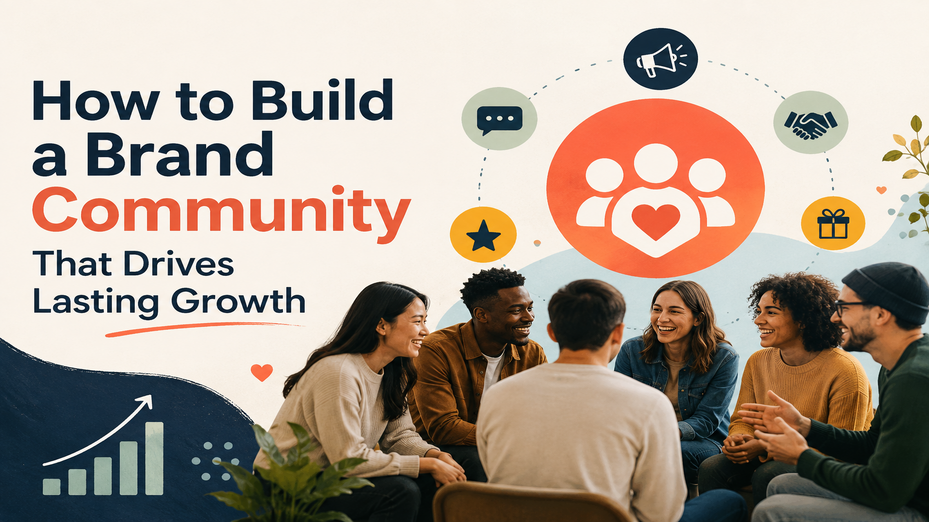
If you are wondering how to build a brand community, start with a simple question: why would people want to gather around your brand when they have countless other options? A community is more than a social media following. It is a group of people who interact with your brand, share experiences, contribute to conversations and, ideally, become willing advocates. Building one takes more than posting regularly. It requires a clear purpose, useful content, genuine interaction and a willingness to listen.
An audience consumes. A community participates.
Someone who follows your Instagram account but never interacts is part of your audience. Someone who comments regularly, shares experiences, answers other customers' questions or recommends your brand to friends is participating in a community.
That distinction matters because community marketing is built around relationships rather than reach alone.
|
Audience |
Brand community |
|
Primarily consumes content |
Actively participates |
|
Interaction is often one way |
Conversation happens in multiple directions |
|
Follows for information or offers |
Returns because there is ongoing value |
|
Reach is a key measure |
Engagement and advocacy matter |
|
Brand creates most of the content |
Members can contribute too |
Follower growth still has value, but it should not be mistaken for community growth.
People can discover another product, service or creator within seconds. What is harder to replicate is a sense of connection.
A well developed community can help a business:
There is an important caveat, though. Creating a Facebook group, WhatsApp community or Instagram broadcast channel does not automatically create loyalty.
People stay when the experience gives them a reason to stay.
There is no single platform, campaign or content format that builds a community overnight. The process starts with understanding what people have in common and then creating consistent opportunities for them to participate.
Ask yourself:
Why would someone want to be part of this community?
The answer needs to go beyond "to hear about our products".
For example, a fitness brand could create a space where members exchange training experiences and encourage one another. A B2B software company could build a professional community around solving industry specific challenges. A beauty brand could encourage customers to share routines, experiences and advice.
The strongest communities are built around a shared interest, challenge, identity or aspiration.
If every conversation begins and ends with the brand, there is little reason for members to connect with one another.
One of the biggest mistakes businesses make is deciding what the audience should discuss before finding out what it actually wants to discuss.
Start by examining:
This research can become the foundation of both your content and community strategy.
At GBIM, we approach content marketing by considering the audience's needs, developing relevant content and using performance insights to refine the approach. The same principle applies to community building: listen first, create second and optimise continuously.
Explore our Content Marketing Services
Publishing consistently does not necessarily create engagement.
Instead of asking, "What should we post today?", ask, "What could we invite our audience to contribute?"
You could use:
Questions:
"What is the biggest challenge you are facing with X?"
Opinions:
"Which approach works better for you and why?"
User generated content:
"Show us how you use X in your everyday routine."
Behind the scenes content:
"Here's how this product was developed. What would you have done differently?"
Interactive formats:
Polls, Q&A sessions, live discussions and challenges can make participation easier.
The objective is not to manufacture engagement. It is to create conversations people actually want to join.
There is no universally correct platform.
The right choice depends on where your audience already spends time and how they prefer to interact.
Instagram can work well for visual brands and creator led communities. LinkedIn may be more appropriate for B2B audiences interested in professional knowledge and industry discussions. Email, private groups, forums or communities hosted on your own website can make sense for businesses that need deeper conversations.
Before choosing a platform, consider three questions:
At GBIM, our social media marketing approach focuses on creating relevant content, engaging audiences and managing social interactions as part of a broader digital strategy.
Explore our Social Media Marketing Services
The platform matters, but the strategy behind it matters more.
Community content has a different job from conventional promotional content. It should encourage people to learn, respond, contribute or share.
A useful mix can include:
Educational content
Help people solve a problem without immediately asking them to buy something.
Conversation starters
Ask specific questions rather than generic questions such as "What do you think?"
Customer stories
Show how real customers use a product or service.
Behind the scenes content
Let people see the people, decisions and processes behind the brand.
Interactive content
Use polls, Q&A sessions, challenges and live conversations to lower the barrier to participation.
Recognition content
Highlight useful contributions from community members.
That final point is easy to underestimate. When people see that their contributions are noticed and valued, participation becomes more rewarding.
A community can look impressive from the outside while being surprisingly quiet underneath.
That is why follower count should never be the only metric.
Consider tracking:
The right metrics depend on your objective.
If awareness is the goal, reach and engagement may matter more. If retention is the objective, returning participation and customer behaviour become more useful. If the community supports lead generation, influenced conversions deserve attention.
At GBIM, we believe measurement should inform what happens next. Our broader content and digital marketing approach uses reporting and performance insights to identify what is working and where adjustments are needed.
A community strategy should work the same way. Do not simply collect numbers. Look for behavioural signals.
Community building often fails because of a few predictable mistakes.
Making every interaction promotional
If every conversation ends with a sales message, members will eventually disengage.
Chasing follower numbers
A smaller, active community can be more valuable than thousands of passive followers.
Ignoring criticism
Not every negative comment needs to become a crisis. Sometimes it is useful customer feedback that reveals something worth addressing.
Posting without responding
A brand cannot build a relationship by publishing and disappearing.
Copying another brand's community
A successful format elsewhere may not fit your audience, product or culture.
Expecting immediate results
Trust develops through repeated interactions. Community building is a long term activity, not a short campaign.
Community led marketing sits across several disciplines. Social media creates spaces for interaction. Content gives people something useful to discuss. Creative work makes the experience recognisable. Influencer and creator collaborations can introduce new voices. Analytics helps determine whether those efforts are producing meaningful business outcomes.
At GBIM, we bring these disciplines together when they are relevant to a client's objectives. Our capabilities include social media marketing, content marketing, influencer marketing, digital branding and social media advertising.
We do not see community building as simply another requirement on a social media posting calendar. It needs to connect with the wider brand and marketing strategy.
Our work across digital marketing also reflects a broader focus on measurable outcomes. You can explore our published case studies to see examples of how we approach different digital marketing challenges.
View our Digital Marketing Case Studies
The strongest communities do not feel like permanent advertising campaigns.
They have conversations when there is nothing to buy. They listen when customers have concerns. They recognise useful contributions. They give people a reason to return even when there is no promotion running.
That is ultimately how to build a brand community that lasts: define a shared purpose, understand what people genuinely care about, create opportunities for participation and keep listening to what the community tells you.
For brands looking to make social media more meaningful, we believe the strongest approach connects community activity with content, audience understanding and measurable digital objectives. At GBIM, that integrated thinking helps us look beyond follower counts and focus on the relationships and business outcomes that make a community worth building.
A brand community is a group of customers, followers or enthusiasts connected by a shared interest in a brand, its products, its values or the problems it helps solve.
There is no fixed timeline. Meaningful communities develop through consistent interaction, useful content and repeated opportunities for members to participate.
There is no single best platform. Choose the channel where your audience already interacts and where your business can consistently support meaningful conversations.
Track meaningful participation rather than follower count alone. Comments, conversations, shares, user generated content, returning participants, referrals and influenced conversions can all provide useful signals.
Yes. A smaller community can be highly valuable when its members are genuinely engaged. Relevance and participation matter more than audience size alone.
No. Paid advertising and community building serve different purposes. Advertising can accelerate reach and acquisition, while community activity can strengthen relationships, engagement and advocacy.
Treating the community as another promotional channel. People participate when they receive value, feel heard and have a genuine reason to connect with others around a shared interest.
309, Rupa Solitaire,
Sector-1, Millennium Business Park,
Mahape, Navi Mumbai,
Maharashtra (400 710), INDIA.
Write to us at
hr@gbim.com