
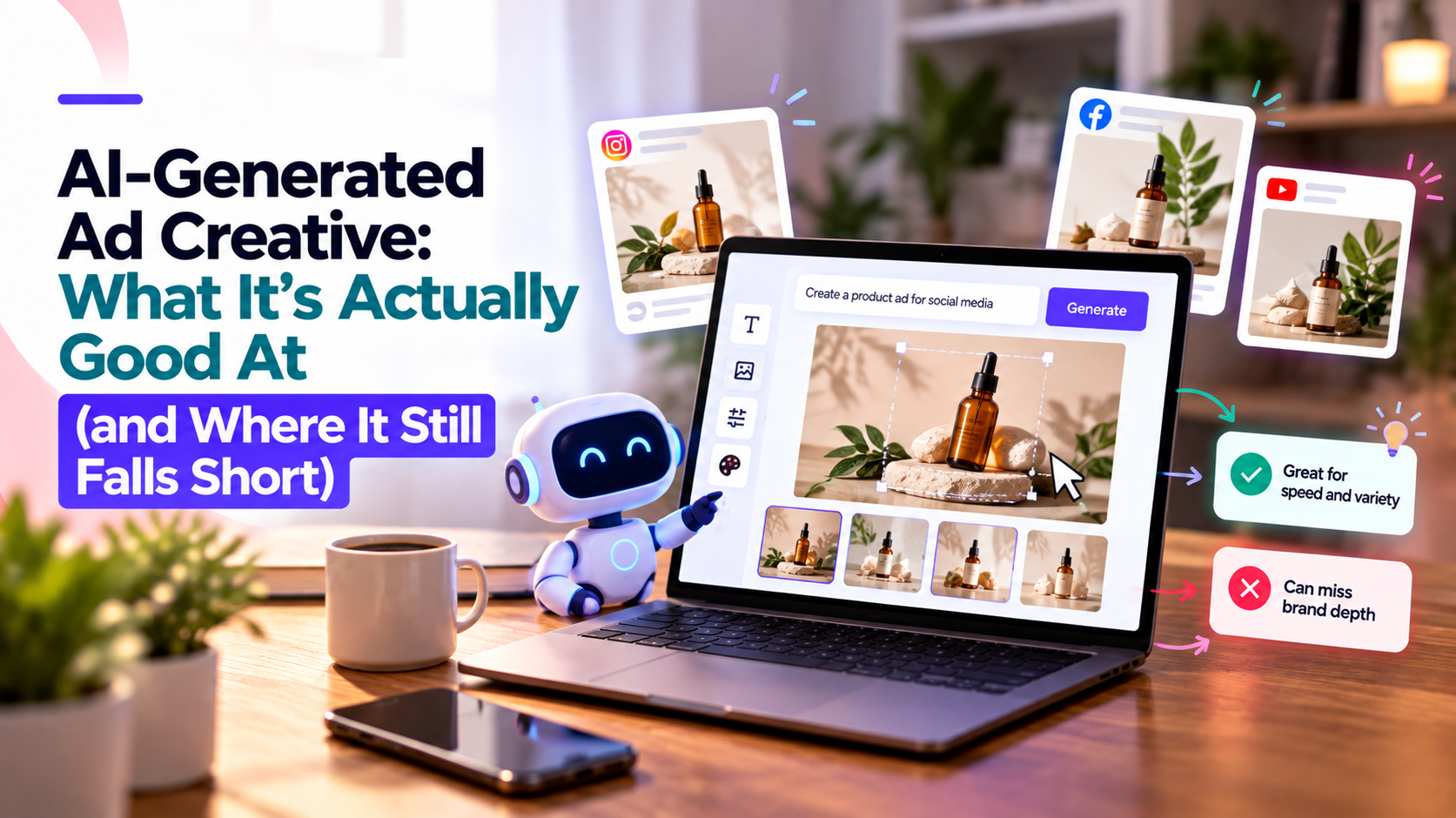
A product displayed on a marble counter. A light source is a window that diffuses light. Perfectly placed shadows. Model who looks somewhat similar to the model but doesn't exist.
You can now get an ad like this from an AI within minutes by requesting it.
That's the reason why generative advertising is so exciting. However, the question of AI-generated ads quality is not as straightforward as one might think; simply looking polished on the surface is not enough. An ad must be believable, it must convey the right message, it must be accurate, it must be meaningful to the ad's audience.
AI can really help with a portion of that work in 2026. It simply isn't equally good at everything.
The strongest case for AI is not "replace the creative team." It is giving that team more room to experiment.
Imagine a team has approved a campaign idea but needs different visual directions for social feeds, display ads, and other placements.
Creating every variation manually can slow experimentation. Generative tools can help explore:
The important detail is that the core idea already exists.
AI is far more effective at answering the question "how can I improve this direction on a brand?" than answering the question "what is the direction for a brand?".
That makes it particularly useful during exploration and iteration.
Innovative conversations can turn out to be surprisingly ineffective.
A marketer says, "Make it premium, but warmer."
A designer hears something different.
The client imagines something else again.
AI mockups can provide everyone with something to respond to. They aren't required to be the last ad. Sometimes they can be just a way for a team to find out what it wants and doesn't want.
This aligns nicely with a wider design thinking approach, in which exploration and iteration occurs prior to a final creative direction.
Not all ads require a brilliant concept and idea.
In some cases, a team has a successful visual language and just needs more variations to it that can be used. AI can help with the adaptation of tasks that need less skill and designers can focus on more judgmental decisions.
That distinction matters.
AI is strongest when the question is "How many useful versions can we explore?"
It is far less dependable when the question becomes:
"What should this brand mean to people?"
That second question is where the limitations become obvious.
|
Creative task |
Where AI helps |
Where humans still matter most |
|
Concept exploration |
Producing visual directions quickly |
Choosing the right direction |
|
Ad variations |
Creating multiple alternatives |
Deciding what remains on-brand |
|
Copy options |
Generating starting points |
Tone, nuance and final wording |
|
Product visuals |
Exploring settings and compositions |
Product accuracy and credibility |
|
Video ideas |
Storyboards, visual concepts and supporting assets |
Story, pacing and emotional intent |
|
Localization |
Providing initial variations |
Cultural meaning and context |
The pattern is fairly consistent: generation scales more easily than judgment.
The image might be beautiful, but if it's a bad advertisement, it is a bad advertisement.
This is where discussions about AI generated ads quality often become too focused on visual realism.
An AI-generated image can be well lit, have a great composition and be very realistic with the texture and details, but have an incorrect brand.
There are unwritten rules for a mature brand.
Maybe it's a shallow joke instead of a loud one. Perhaps, photography purposefully doesn't look perfect. Maybe products are always presented simply since credibility counts a great deal more than spectacle.
Such choices are hard to boil down to a question.
AI is capable of carrying out explicit instructions, but sometimes creative judgment means knowing not to do the obvious.
That's why creative direction by humans is still important. Our own design portfolio illustrates the broader point: creative works are not one and the same, with all of them having to fit into one standardised visual template.
Think of a marketing campaign around a festival in India.
Some of the obvious elements, such as clothes, decorations, food, lights, family gatherings etc., are not so difficult to get into an image.
The social aspects are more difficult.
Who is doing what? Does the setting feel natural? Does the humor work locally? Is a gesture appropriate? Is it a real life situation or is it the visual shorthand of an AI model for "Indian festival"?
These details can be small, but it stands out.
Cultural understanding doesn't equal the creation of culturally recognisable products.
This is especially crucial for product promotion.
When packaging is subtly different, has a new feature, new proportions, new logo, or shows something the product can't actually achieve, it's not just about looks.
The creative is now showing something that is not true.
A sensible workflow therefore separates creative freedom from factual freedom.
Backgrounds may be flexible. Mood may be flexible. Composition may be flexible.
The product, claim, identity, and important brand elements often are not.
There's another reason review is important - people are increasingly aware of synthetic advertising.
In January 2026, IAB research revealed a persistent disconnect between advertising executives and surveyed Gen Z and Millennial consumers on their views of AI-driven advertising. The organization then went on to revise its AI Transparency and Disclosure Framework in August, highlighting that the disclosure of AI should be done on a context-by-context basis and not be applied uniformly.
The Advertising Standards Council of India has also introduced guidelines on responsible labelling of artificially produced advertising content, in India, in September 2026.
So the question is no longer simply, "Can we generate this?"
Teams increasingly need to ask:
Should we generate it this way, is it truthful, and does the audience need to know?
Instead of handing the campaign to AI, put AI in the middle.
Define:
Use it to generate concepts, alternatives, supporting visuals, copy directions, or production ideas.
Check every promising output for:
Some ideas may remain AI-assisted assets. Others may become references for designers, photographers, editors, or a professional video production team.
AI does not have to create the final asset to have saved considerable time earlier in the process.
There is a temptation to judge an AI ad by asking, "Can you tell this was generated?"
That is the wrong benchmark.
An ad can look completely real and still be generic.
The better questions are:
Does it feel specific to this brand? Does it communicate something worth remembering? Is the product represented honestly? Would this idea still be interesting if the novelty of AI disappeared?
If the answers are weak, photorealism will not rescue the campaign.
That is ultimately where AI generated ads quality should be judged: not by how impressive the generation technology looks, but by whether the resulting creative does its actual advertising job.
The middle ground that can be useful is becoming more apparent. Creative exploration can be done quicker, provide teams with greater variation to explore, and eliminate some repetitive production work. It doesn't always provide the taste, context, or brand judgment or insight into the "why" of an idea.
We're all about creative thinking and production here at GBIM and creating campaigns around the brand, not around whatever new tool is just emerged. AI can be utilized in a way that enhances the process without losing sight of the human touch in the final output to the viewer.
They can be, depending on the asset and campaign. AI can produce useful visual and copy variations, but important creative should still be reviewed for brand consistency, accuracy, cultural context, and advertising claims.
It is particularly useful for early concept exploration, creating variations, developing rough visual directions, assisting with copy options, and adapting established ideas into additional formats.
AI can automate or accelerate parts of creative production, but generating assets is only one part of advertising. Brand strategy, judgment, storytelling, cultural understanding, and final quality control still require strong human input.
Generative systems can produce polished imagery without understanding what makes a particular brand distinctive. Without strong references and creative direction, different brands can end up using similar compositions, language, and visual styles.
That depends on how AI was used and the rules that apply to the campaign. Transparency frameworks are evolving. In India, ASCI released guidelines in September 2026 addressing responsible labelling of synthetically generated advertising content, while IAB has also published an updated disclosure framework.
Start with controlled tasks rather than handing over the entire campaign. Give the system clear brand inputs and boundaries, use it to expand approved ideas, and have people review the final output for accuracy, relevance, and brand fit before publication.
309, Rupa Solitaire,
Sector-1, Millennium Business Park,
Mahape, Navi Mumbai,
Maharashtra (400 710), INDIA.
Write to us at
hr@gbim.com