
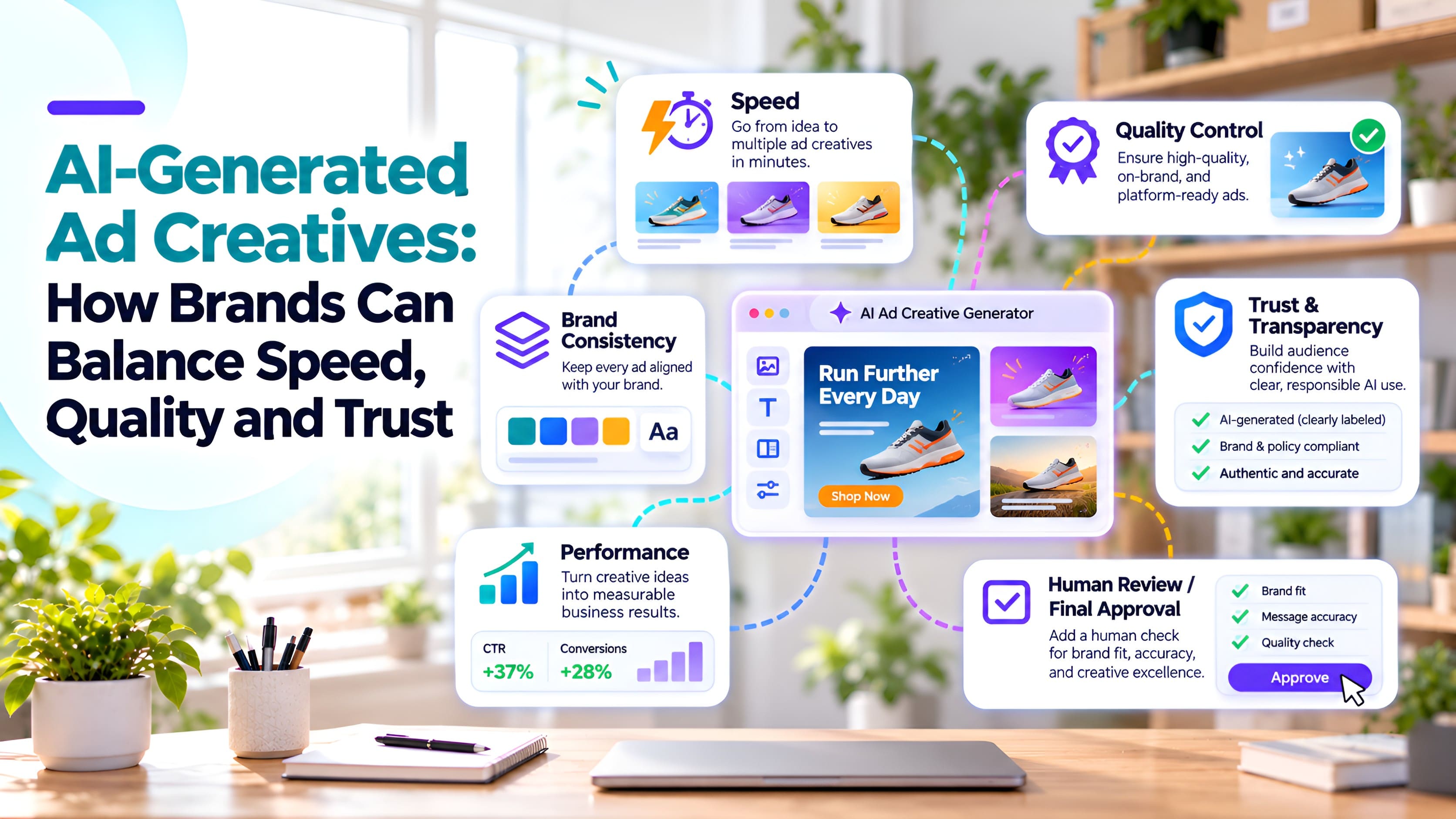
A marketing team is developing a promotion for the holidays for an online retailer. The team still needs to prepare: Product visuals, catchy headlines and different versions of the ads for Instagram and Google Ads.
AI tools can quickly generate a whole host of creative concepts. Whereas, previously, it used to take several rounds of brainstorming sessions and design, it can now start with a brief.
However, with the rapid production comes an extremely important question: are these ads accurate, relevant and trustworthy?
AI generated ad creatives can help businesses develop campaign ideas, testing out visual ideas, and crafting variations of content. But it's not just a matter of speed, it's a matter of the success of advertising.
Brands require a solution that is both practical and combines AI features with creative, quality checks and performance metrics.
Digital advertising is a constantly evolving medium which is always subject to experimentation. While this can work on Instagram, it does not always work on Google Display or LinkedIn.
Marketing teams need to generate inventive material to various audiences, places, and campaign goals.
AI can help with a number of tasks:
Google Ads is the AI-powered creative tool in the Google ecosystem and Meta AI is the one in the Meta ecosystem.
But these tools are most beneficial when marketers already know their audiences, brand positioning and campaign goals.
Consider a furniture company using AI to develop advertisements for a new sofa collection.
The pictures that are produced are visually impressive. Unfortunately, some are not the same stitching, proportions and colors that are not in the original collection.
The ads may grab customers' attention, but they may not get a correct idea about the products.
Thus, a problem arises which cannot be solved by making products faster.
|
Creative risk |
Possible consequence |
Recommended action |
|
Inaccurate product visuals |
Misleading expectations |
Compare images with approved references |
|
Generic advertising copy |
Weak brand differentiation |
Follow established brand guidelines |
|
Unsupported claims |
Reduced credibility |
Verify statements before publication |
|
Excessive creative variations |
Unfocused testing |
Prioritise distinct advertising ideas |
|
Inconsistent visual identity |
Poor brand recognition |
Maintain approved colours and design elements |
The objective is to achieve better creatives, not more ads.
While AI can create content from a set of directions, it is still the marketer's job to determine if the content is delivering the desired message.
There are three areas that are of special concern.
The home buyer may be more interested in connectivity and location, whereas the office furniture buyer may be more interested in comfort and space.
If the campaign brief doesn't support actual research from the customer, these priorities might be overlooked when using AI suggestions.
A youth fashion brand may use playful messaging, and do so in a funny manner, using a playful language. Professional consulting firms may want clarity and reassurance.
The fact that they are all the same style would make them blend together.
AI can produce misleading visuals and unsupported advertising claims.
Human readers should check to ensure that all ads accurately represent the product or service being advertised.
A basic review process can be used for businesses to ensure that a campaign is creative without slowing down the process.
Determine target audience, campaign goal, product information & approved claims, and intended customer action.
Extraneous creative suggestions are minimised by clear instructions.
Brainstorm ideas, then narrow them down to the best ideas to satisfy customers.
Avoid the temptation to develop dozens of full ads first to find out which ones to test.
Check pictures, text and logos, promotions, call to action.
In terms of physical products, make the AI-generated images look like a real product reference.
Google Ads has policies in place to protect the integrity of ads that are created, while Meta has introduced transparency requirements for ads made with AI and significantly altered ads.
Prior to posting, businesses should read platform policies for disclosures and local policies.
Delegate the accuracy of the facts, visual uniformity and relevance for the customer.
AI can help with production, but the final decision of publishing needs to be accountable.
There's some benefit to having multiple ads when companies can determine which ones are effective and which ones aren't.
For example, if a retailer sells on the internet, then he or she might compare 2 completely different messages.
The retailer can test what messages bring in the right traffic and persuade the right types of customer actions.
When testing AI generated ad creatives, businesses should change one major variable at a time to understand what influences performance.
Testing has to be done to answer a question, and not to see who clicks on which ad.
An ad can be noticed but not be of interest.
It's best for businesses to look at engagement and commercial results.
|
Performance indicator |
What it reveals |
|
Ability to attract attention |
|
|
Conversion rate |
Ability to encourage intended actions |
|
Lead quality |
Relevance of enquiries |
|
Customer feedback |
Clarity and credibility of messaging |
|
Brand consistency |
Alignment with approved identity |
|
Creative fatigue |
Whether audience response weakens over time |
These are the metrics that can help you find creative items that will be desirable to marketers, including ads that will be helpful.
Also, the performance of the campaign should be measured against targeting and landing page quality and conditions.
Yes, as long as companies are forthright and accountable.
Customers should not encounter fabricated testimonials or misleading product visuals that claim to be authentic.
Intellectual property rights, customer privacy, and the disclosure of AI-generated content are also important factors to consider for brands.
The best way to do this is to consider AI-generated content as content that needs to be verified and not automatically classified as advertising.
It enables businesses to obtain the advantages of more rapid growth of their creations without losing their customers' trust.
AI is revolutionizing advertising teams' creative idea generation and testing processes. The message, however, is the most important part of successful campaigns, and having information on the products and knowledge of their customers' expectations.
Brands that are able to automate along with human judgment can create more meaningful ads without losing their creative freedom.
At GBIM, we can assist businesses link creative strategy, audience insights and performance marketing to help drive quantifiable growth. We work on the creation of advertising strategies that clearly convey messages, captivate the attention of relevant customers and enhance trust over long-term brand communication.
The actual challenge isn't to supplant creativity with technology. It's technology to advance thoughtfully and creatively.
AI-generated ad creatives are advertising visuals, headlines, descriptions or other campaign assets created or modified using artificial intelligence. Businesses use them to explore creative ideas, develop variations and support advertising production.
They can perform well, but AI involvement does not guarantee stronger results. Performance depends on audience relevance, messaging, targeting and campaign execution. Businesses should compare creative approaches through meaningful testing.
Brands should establish clear guidelines covering tone, colours, typography, product representation and approved claims. Human reviewers should assess generated content against these guidelines before publication.
Commercial suitability depends on the generation tool's terms, intellectual property considerations, content accuracy and advertising platform requirements. Businesses should verify usage permissions and applicable rules before publishing generated visuals.
Both platforms support AI-assisted advertising features, subject to their respective policies. Generated content must meet advertising standards, and certain AI-created or edited assets may require disclosure or receive platform-generated labels.
Small businesses can use AI to support brainstorming, content adaptation and creative experimentation. However, they still need accurate product information, relevant campaign objectives and human oversight to maintain advertising quality.
309, Rupa Solitaire,
Sector-1, Millennium Business Park,
Mahape, Navi Mumbai,
Maharashtra (400 710), INDIA.
Write to us at
hr@gbim.com