
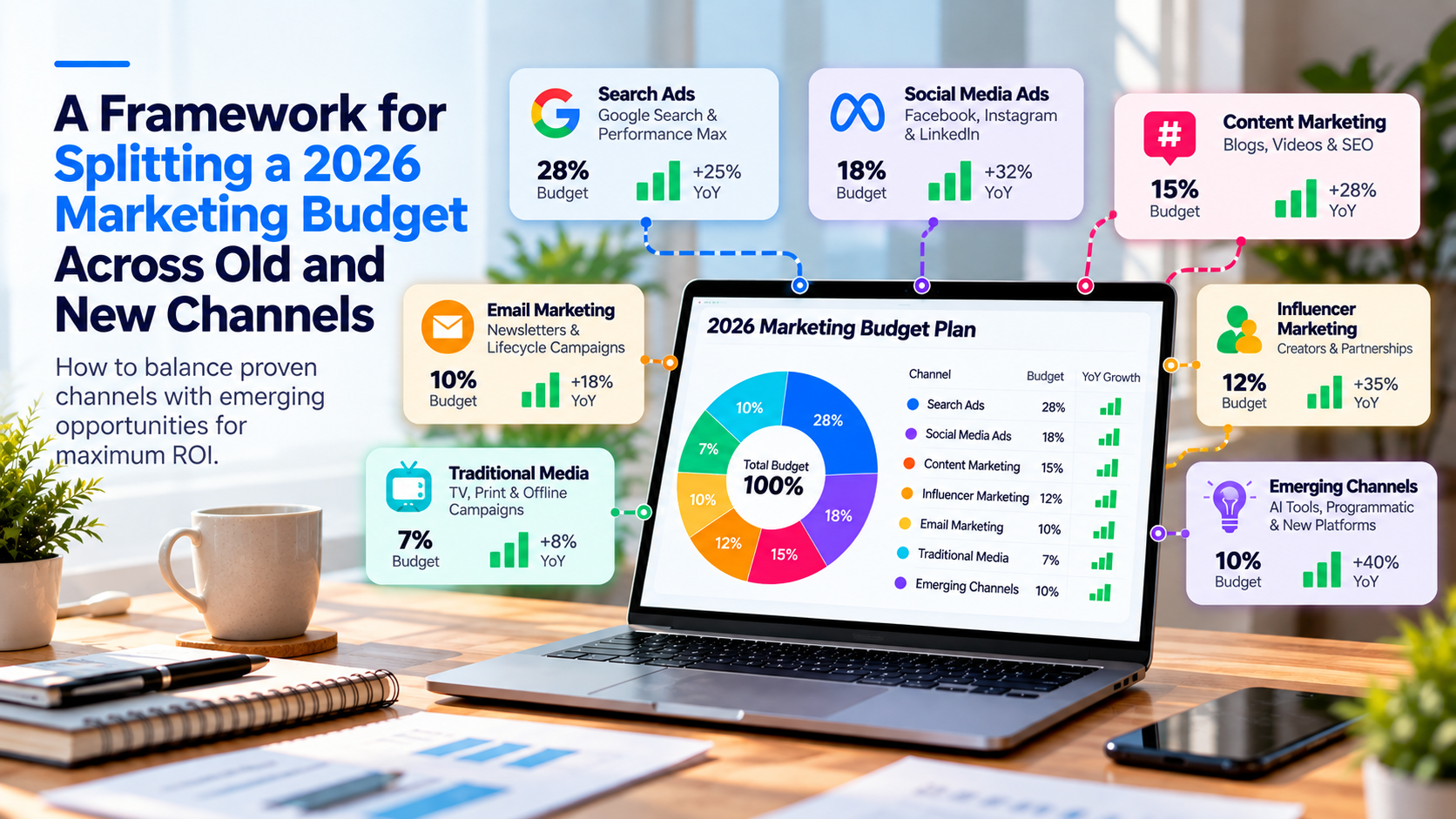
Most marketing budgets are not planned. They are inherited. A marketing director opens last year's spreadsheet, adjusts the totals by a few percentage points, adds a new line item for whatever platform the CEO read about on a flight, and calls it a strategy.
This approach worked well enough when the channel mix was stable. It does not work for 2026 marketing budget allocation because the ground has shifted under every major advertising category simultaneously. Search costs have climbed steadily for three years. Social ad performance is degrading in categories that used to print money. Retail media networks are demanding budget that did not exist in previous plans. And AI-powered buying tools are changing how platforms spend your money whether you asked them to or not.
The question is not whether to change your allocation. The question is how to do it without wrecking the channels that currently pay your bills.
For most of the 2010s, the default split was simple. Put the majority into paid search to capture demand, allocate a meaningful slice to paid social for awareness and retargeting, fund SEO as a long-term hedge, and keep email running on minimal spend because it was cheap and effective.
That logic assumed stable auction dynamics. Google search cost per click in competitive categories has roughly doubled since 2020 in many verticals. Meta's automation tools have simplified campaign management but compressed the performance gap between sophisticated and unsophisticated advertisers, meaning your competitive advantage on social is narrower than it was.
At the same time, consumer attention has fragmented. Your customers are now watching streaming content on connected TVs, buying groceries through quick commerce apps, and asking AI chatbots for product recommendations before they ever visit a search engine. None of these behaviours existed at scale five years ago.
A budget built around 2021 assumptions will overspend on saturated auctions and underspend on channels where your audience has actually moved.
The instinctive reaction to fragmentation is to spread budget across every emerging platform. This is a mistake, and it is a particularly expensive one for mid-sized businesses with limited cash reserves.
Retail media advertising, connected TV, quick commerce placements, and agentic commerce feeds are all real opportunities. But they are not equally mature, equally measurable, or equally relevant to every product category. A direct-to-consumer skincare brand selling through its own website has a completely different retail media opportunity than a packaged food company selling through grocery delivery apps.
Throwing 15% of your budget at a new channel because an industry report says it is growing at 40% year on year is not a strategy. It is a bet. And bets require different risk management than investments.
Rather than prescribing a universal percentage split, a more useful approach is to sort your channel decisions into three categories based on evidence rather than enthusiasm.
Defend. These are channels where you have clear, recent data showing profitable customer acquisition. Paid search for high-intent brand and category terms usually falls here. So does email retention if your repeat purchase rate is healthy. The rule for defend channels is simple: do not cut them to fund experiments unless the marginal cost per acquisition has crossed your profitability threshold.
Expand. These are channels with promising early data that need more investment to validate at scale. Maybe your connected TV test last quarter delivered strong brand lift at a reasonable cost. Maybe a retail media pilot on a quick commerce app drove incremental sales you could not attribute to any other source. Expansion channels deserve real budget, but they also deserve strict performance gates. If the numbers do not hold up over two consecutive quarters, move the money back to defend.
Probe. This is your research budget. Five to ten percent of total spend, allocated to channels and formats where the evidence is thin but the potential audience overlap is real. Agentic commerce placements, new AI-powered ad formats, experimental programmatic deals. The purpose of probe spend is to generate data, not revenue. If a probe test produces useful learning about customer behaviour, it has done its job even if the immediate return on ad spend looks poor.
The proportions between these three categories will look very different for a bootstrapped startup compared to a funded consumer brand compared to a legacy enterprise. A startup might run 85/10/5 because it cannot afford to waste cash. A mature brand with strong cash flow might run 55/30/15 because it needs to find the next growth lever before its core channels plateau.
Any budget discussion that does not address attribution is incomplete. The uncomfortable reality of digital advertising budget planning in 2026 is that platform-reported performance metrics are increasingly unreliable as standalone decision inputs.
Meta and Google both claim credit for conversions that would have happened organically. Retail media networks report sales lift figures that are difficult to independently verify. Connected TV platforms provide strong completion rates but weak downstream conversion data.
Before you reallocate budget based on reported channel performance, cross-reference platform data against your own first-party sales records, customer surveys, and incrementality tests. A channel that looks expensive on a last-click basis might be driving significant assisted conversions that your attribution model is ignoring.
The single biggest determinant of your marketing budget planning 2026 allocation should be your company's financial position, not the latest industry forecast.
If your unit economics are unproven, concentrate spend on one or two channels where you can measure direct revenue impact within a short payback window. Diversification is a luxury that requires a working acquisition model.
If your core channels are performing well but growth is slowing, that is the right moment to fund expansion channels aggressively. You have the cash flow to absorb some inefficiency while you learn.
If you are under margin pressure, cut your probe budget to zero and focus entirely on defend channels with the shortest path to cash. Experimentation requires financial breathing room.
Start by auditing your current spend against actual contribution margin, not platform-reported return on ad spend. Identify which channels are genuinely profitable at the margin and which are coasting on historical momentum. Then allocate your defend, expand, and probe budgets based on that evidence.
Review the split quarterly. Move channels between categories as the data changes. Kill experiments that are not generating useful learning. Double down on expansion channels that are delivering verified incremental revenue.
Building a defensible 2026 marketing budget allocation requires honest numbers, clear priorities, and the discipline to resist both inertia and hype. At GBIM, we help businesses cut through the noise with data-led digital marketing strategy and marketing consulting services that focus on commercial outcomes rather than vanity metrics. With over 21 years of experience across performance marketing, media planning, and business growth, our team can help you build a budget that actually reflects where your customers are and where your money works hardest.
How much of my marketing budget should go to new channels in 2026?
There is no universal percentage. A practical starting point is 5% to 10% for experimental channels, 15% to 25% for validated growth channels, and the remainder in proven performers. Adjust based on your cash flow and risk tolerance.
Should I cut paid search to fund emerging channels?
Only if your marginal cost per acquisition on search has risen above your profitability threshold. Cutting a profitable channel to chase unproven ones is the most common budget allocation mistake.
How do I measure whether a new channel is working?
Track incremental revenue against a baseline period, not just platform-reported conversions. Use controlled tests with clear start and end dates, and compare results against your existing channel benchmarks.
Is the 70/20/10 budget model still relevant?
It is a useful starting framework but not a rule. A cash-constrained startup should concentrate spend more heavily, while a mature brand with strong margins can afford a larger experimentation allocation.
How often should I reallocate my marketing budget?
Review channel performance monthly and make formal reallocation decisions quarterly. Avoid reacting to single-week fluctuations, but do not wait for annual planning cycles to correct underperforming spend.
309, Rupa Solitaire,
Sector-1, Millennium Business Park,
Mahape, Navi Mumbai,
Maharashtra (400 710), INDIA.
Write to us at
hr@gbim.com