
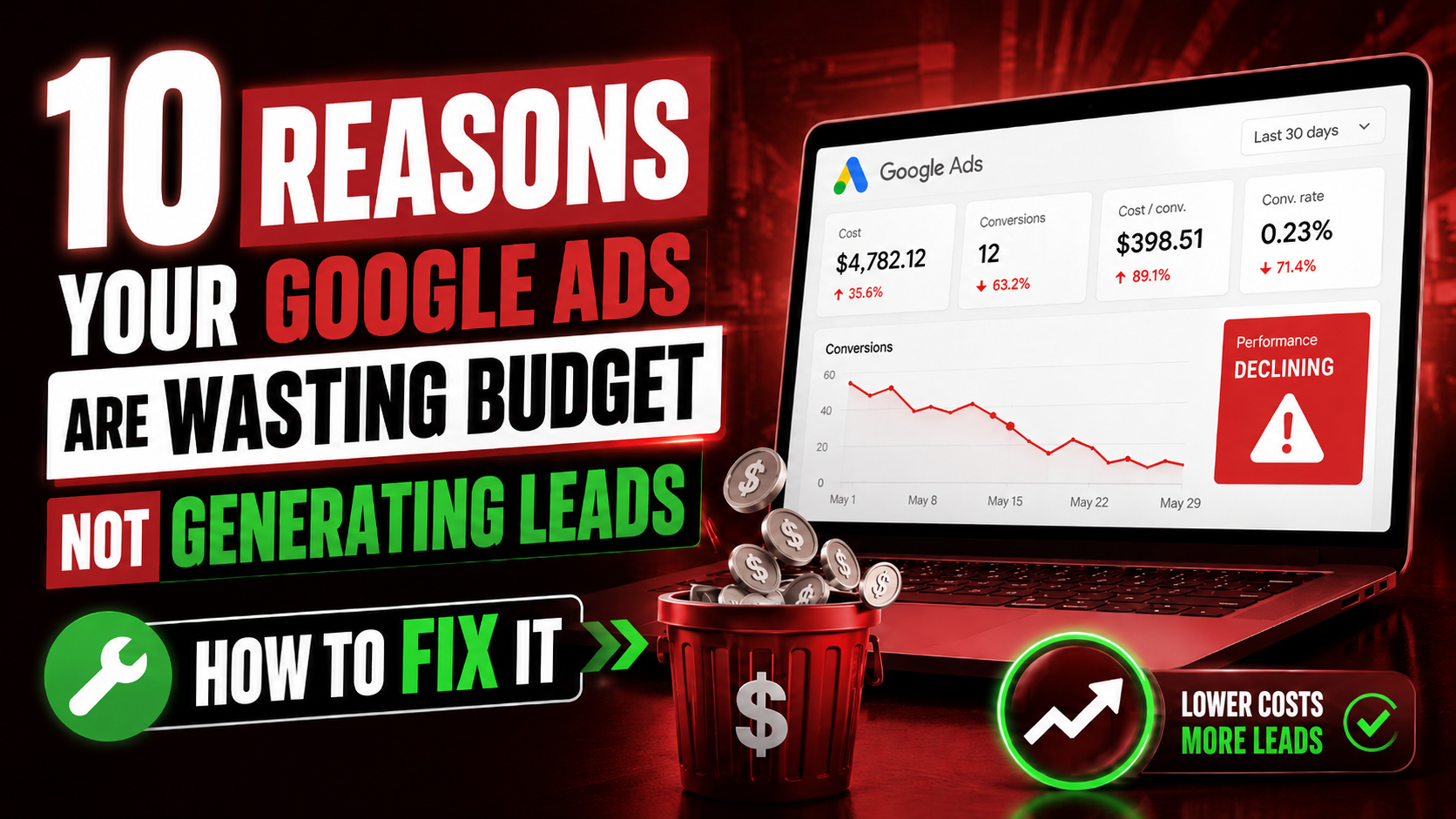
Running Google Ads should feel like growth. More inquiries. Better visibility. Consistent leads coming in.
But for many businesses, it turns into a cycle of rising ad costs and disappointing results. The clicks keep increasing, budgets disappear quickly, and yet the sales team still complains about poor-quality leads or no leads at all.
At GBIM, we’ve audited campaigns where businesses were spending aggressively on Google Ads while unknowingly paying for irrelevant traffic, weak landing experiences, and keywords with almost no buying intent. Sometimes the issue is technical. Sometimes it’s strategic. Most of the time, it’s a mix of both.
The difficult part is that Google Ads rarely fails loudly. Campaigns can look healthy on the surface while quietly wasting money underneath.
Here are some of the biggest reasons that happen and what businesses can do differently.
A keyword with high search volume looks tempting. More searches should mean more opportunities, right?
Not always.
A lot of businesses build campaigns around broad terms like "SEO", "CRM software", or "digital marketing". These keywords attract massive traffic, but the intent behind them is all over the place. Some users are researching. Some are students. Some are comparing tools without any intention of buying soon.
The result is expensive clicks with weak conversion rates.
A better approach is to target searches that show commercial intent. Someone searching for "Google Ads management company for ecommerce" is much closer to taking action than someone searching simply for "Google Ads".
That difference matters. Intent-driven keywords usually bring fewer clicks, but much better leads.
This problem drains budgets faster than most businesses realize.
Without negative keywords, Google may display ads for searches connected to:
A company selling premium PPC management services should not be paying for clicks from users searching "learn Google Ads free".
Yet it happens constantly.
Adding negative keywords sounds basic, but many campaigns either ignore them completely or stop updating them after launch. That creates leakage month after month.
Search term reports often reveal where a large part of the wasted spend is hiding.
This is where many campaigns collapse.
The ad sounds convincing. The user clicks. Then they land on a slow, cluttered page that barely connects with what they searched for.
People do not want to hunt for information after clicking an ad. They want immediate confirmation that they are in the right place.
If someone clicks an ad for healthcare PPC services, they expect to land on a page speaking directly about healthcare marketing. Not a generic homepage listing ten unrelated services.
Small disconnects create hesitation. Hesitation kills conversions.
A focused landing page with clear messaging, trust signals, faster speed, and a strong call-to-action usually performs far better than a broad company website.
A lot of Google Ads blend together because they repeat the same phrases:
Users scroll past these lines without even noticing them anymore.
The issue is not visibility. The issue is sameness.
Good ad copy sounds specific. It addresses a real business problem instead of trying to sound impressive.
There’s a difference between:
"Professional PPC Services"
and:
"Reduce Cost Per Lead With Smarter Google Ads Campaigns"
One sounds generic. The other sounds connected to an actual business outcome.
That shift in messaging changes how users respond.
Clicks are easy to celebrate because they make campaigns look active.
But traffic without conversions is just expensive.
Some campaigns generate thousands of visitors while producing almost no real business impact. Usually because optimization revolves around metrics like impressions and click-through rates instead of qualified leads and customer acquisition.
At some point, every business running Google Ads has to ask a harder question:
Are these clicks turning into revenue?
If the answer is no, the campaign strategy needs reworking, even if the traffic numbers look strong.
Most paid traffic now comes from mobile devices, yet many landing pages still feel difficult to use on a phone.
Users lose patience quickly on mobile.
A poor mobile experience increases bounce rates even when the ad targeting is correct. Businesses often blame the campaign itself when the real problem starts after the click.
Cleaner layouts, faster loading speeds, click-to-call functionality, and shorter forms can improve conversion rates more than increasing ad budgets.
Not every user converts during the first visit.
Without remarketing, many businesses lose interested users halfway through the decision process.
This is especially common in industries where services involve higher investment or longer decision cycles.
Remarketing helps bring users back with:
People who already know the brand usually convert more easily than completely cold audiences.
Google rewards relevance.
When keywords, ads, and landing pages feel disconnected, Quality Scores drop. That usually means higher CPCs and weaker visibility.
A surprising number of businesses try fixing this by increasing budgets instead of improving campaign alignment.
But relevance matters more.
If someone searches:
"Google Ads agency for dentists"
The ad and landing page should clearly speak to dental marketing. Generic messaging weakens the user experience and pushes costs higher over time.
The campaigns that perform best usually feel tightly connected from search to conversion.
Google Ads is not a one-time setup.
Search behavior changes constantly. Competitors adjust campaigns. CPCs fluctuate. User intent shifts.
Campaigns that performed well a few months ago can quietly decline if nobody is actively optimizing them.
Regular optimization includes:
Without that process, wasted spend slowly increases.
Sometimes gradually enough that businesses do not notice until budgets become difficult to justify.
This is usually the deeper issue behind underperforming campaigns.
Many businesses focus only on generating traffic. But traffic alone rarely solves growth problems.
Strong Google Ads strategies connect with:
At GBIM, we focus on campaigns that support actual business outcomes, not just ad activity. That means looking beyond impressions and clicks and paying closer attention to how users behave, what drives conversions, and where businesses are losing potential customers during the journey.
Because the real goal is not simply getting traffic.
It’s generating leads that actually turn into business.
This usually happens when campaigns attract low-intent users, landing pages feel disconnected from the ad, or conversion tracking is incomplete.
Negative keywords prevent ads from appearing for irrelevant searches like "free", "jobs", or "tutorials", helping reduce wasted ad spend.
Landing pages influence whether users trust the business enough to take action. Even strong ads fail when landing pages feel slow, generic, or confusing.
Campaigns should be reviewed regularly. Search behavior, competition, and CPC trends change constantly, so ongoing optimization is important for maintaining ROI.
Broad targeting and poor intent matching are two of the biggest reasons. Many campaigns prioritize traffic volume instead of attracting users who are ready to convert.
309, Rupa Solitaire,
Sector-1, Millennium Business Park,
Mahape, Navi Mumbai,
Maharashtra (400 710), INDIA.
Write to us at
hr@gbim.com